Dinosaur Name Activities for Kids
Start with 12 dinosaur names. The set supports four language tasks: matching, describing, comparing, and guessing. In this Dinosaur Names for Kids: Words and Activities guide, children first recognise an animal, name a visible feature, and use a frame such as “It has three horns.” They need not spell every multi-syllable name immediately. Older learners can add comparisons, questions, and four-sentence fact reports, turning the topic into structured English practice instead of a science test.
📥 Dinosaur Name Activities for Kids
Read, match, write, and correct dinosaur names and sentences.
Leave your email — we'll send the PDF to your inbox.No spam — the PDF plus one short reminder. Unsubscribe anytime.
Core Dinosaur Words and Phrases
Start with the twelve names below. Each dinosaur has a visible feature that strengthens memory and gives your child a concrete talking point. Introduce three or four names at a time, then expand the set after confident recall.
Use Dinosaur Names for Kids: Words and Activities as a speaking set, not a silent memorisation list. Pair each noun with two or three reusable words: horn, tail, teeth, claws, plates, crest, long, short, strong, and heavy. A child who forgets “Parasaurolophus” can still point and say, “It has a tall crest.” The message succeeds without the name.
Using Dinosaur Names in Sentences
Teach sentence frames before open speech. Start with “It has…,” “It can…,” “It eats…,” “It is bigger than…,” and “Which dinosaur has…?” When children describe a toy or picture, use the present tense: “It has a curved tail.” For the animal from the past, use “It had a curved tail.”
Build short exchanges from the same words. Ask, “Which dinosaur has three horns?” The child answers, “The Triceratops.” Extend the answer: “The Triceratops has three horns and a frill.” For a guessing game, say, “It has plates on its back. What is it?” The answer is “A Stegosaurus.”
With Dinosaur Names for Kids: Words and Activities, the names create interest while sentence frames build lasting English. The frames also work with wild animals, sea life, toys, and story characters. LearnLink tutors can adjust the word count and answer length to each learner.
Activities for Different Ages
For school-age kids, choose three to five dinosaur figures or cards. Say a name, let your child touch the matching dinosaur, then add an action: stomp, stretch, turn, or roar. Use short instructions: “Find the Stegosaurus,” “Show me the tail,” or “It has plates.” Movement connects each word with its meaning.
For school-age kids, use six to eight names and sort them by visible features. Make groups such as “has horns,” “has an extended neck,” and “walks on two legs.” Then play a description game. One person chooses a card and gives two clues without naming it. The other person guesses in a full sentence.
For school-age kids, add research and comparison. Ask the learner to prepare a four-sentence fact card from a trusted museum or children’s science source. Include appearance, food, movement, and one uncertain or debated point. The task separates evidence from details found in films or games.
Short Practice Ideas for Home
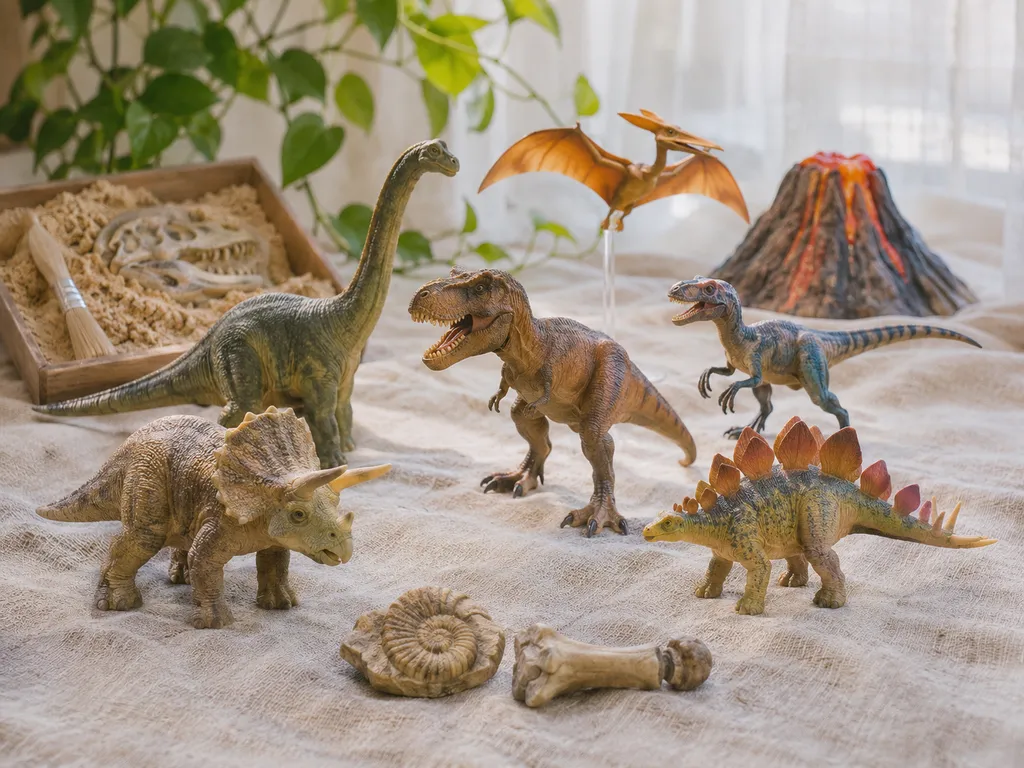
For home practice, the Dinosaur Names for Kids: Words and Activities set fits five-minute rounds. On the first day, match names to pictures. On the second, describe each dinosaur with one feature. On the third, compare two models: “The Brachiosaurus has a taller neck,” or “The Velociraptor is smaller than the T. rex.” Brief returns strengthen recall better than one drawn-out drill.
Dinosaur Detective
Place four dinosaur pictures face up. Give three clues about one picture: “It walks on four legs. It has a sweeping tail. It has plates on its back.” Your child points to the Stegosaurus and says, “It is the Stegosaurus.” Change roles for the next round.
Keep the cards visible during early practice. Hiding them turns language work into a memory test. After the words become familiar, remove one card and ask, “Which dinosaur is missing?” A multilingual child may compare names across languages, but the final clue and answer should remain in English.
Common Mistakes and Simple Corrections
The first mistake is introducing too many multi-syllable names together. If six names become mixed up, return to three contrasting dinosaurs, such as Triceratops, Stegosaurus, and Brachiosaurus. Let speaking develop before exact spelling. Clap difficult names into manageable parts and model them at a steady pace.
Correct grammar through a brief repeat, not a detailed rule. If your child says, “It have three horn,” answer, “Yes, it has three horns.” If the child says, “This one is more big,” model, “This one is bigger.” Keep the exchange moving so correction supports the activity instead of ending it.
Another error is calling every prehistoric creature a dinosaur. Pteranodon was a flying reptile, and Mosasaurus was a marine reptile; neither was a dinosaur. They can still join a prehistoric-animal game. Label them separately and ask, “Did it fly, swim, or walk on land?”
- Choose three dinosaur names from one picture book and pronounce each slowly.
- Correct one sound at a time, then repeat the whole dinosaur name.
- Match each written name to its picture before asking your child to read.
- Sort four dinosaur cards by first letter and say every name aloud.
- Praise accurate attempts, model corrections calmly, and revisit two tricky names tomorrow.
When a word has several meanings or pronunciations, Cambridge Dictionary is a useful check before turning it into child-friendly examples.
Frequently Asked Questions
How Many Dinosaur Names Should a Child Learn First?
Begin with three to five names with distinct shapes. Choose a horned animal, a plated animal, a tall plant-eater, a large predator, and an armoured animal for strong visual clues. Add new dinosaurs after your child can match most of the first set and name one feature. Recognition and spoken use matter more than finishing the list.
Does My Child Need Perfect Dinosaur Pronunciation?
No. The first goal is an understandable attempt. Say the name slowly, divide it into spoken chunks, and let your child repeat it without pressure. Dinosaur names may have more than one accepted English pronunciation. For a school task, check the audio from a reliable dictionary or natural-history museum.
Can Multilingual Children Compare Dinosaur Names Across Languages?
Yes. Comparing names helps a multilingual child notice shared roots, spelling patterns, and different speech sounds. Allow a quick comparison, then return to an English frame such as “In English, this name starts with a T” or “It has three horns.” The other language supports understanding without replacing English speaking practice.
How Can We Keep Dinosaur Practice Interesting?
Use a 4-step, 5-minute routine. First, let your child choose four cards. Next, request two clues about one dinosaur. Then switch roles so your child asks the questions. Finish with one complete English sentence, stop while the game feels lively, and revisit the words in a new format another day.
Want to see how these ideas work in a real lesson — try a LearnLink trial lesson.
Stay updated on our latest tips and resources by following us on Instagram LearnLink.